
Product › In-patient (IPD) › Capacity & consent
Capacity & consent
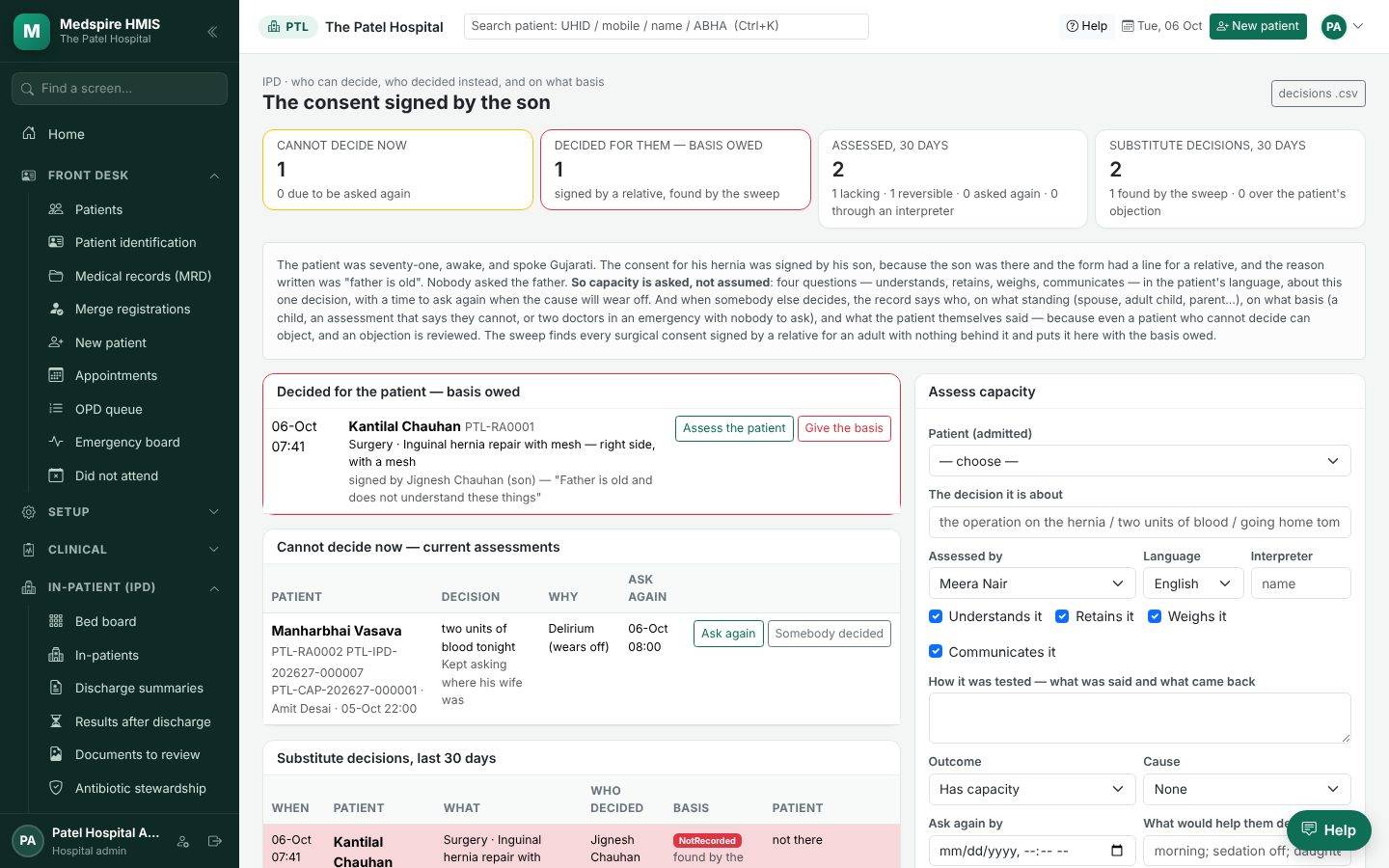
Whether the patient can decide is asked as four questions in their language, not assumed from age or diagnosis, with a time to ask again when the cause wears off; when somebody else decides, the record says who, on what standing, on what basis and what the patient said; and the surgical consent signed by a relative for an adult with nothing behind it is found by the sweep and owed its basis
Why it exists
The patient was seventy-one, awake, and spoke Gujarati; the consent for his hernia was signed by his son because the son was there, the form had a line for a relative, and "father is old" fitted in the box. Sprint 67 made the consent a conversation and made a substitute signature say why — but "why" was a free line, and "old" passed. Capacity was never asked, because nobody had a place to write the answer. Now there is: four questions, in his language, about this operation, and a record of whether he could — and, when he could not, who decided, on what standing, and what he said about it anyway.
In the HMIS: /ipd/capacity
Also in In-patient (IPD)
Bed board
Occupancy at a glance
In-patients
Current admissions
Discharge summaries
What went out, and what went out thin
Results after discharge
Reports that landed once the patient had gone home
Documents to review
Scanned outside records — OCR & extraction
Antibiotic stewardship
The round that walks the live courses — restricted agents, de-escalation, and what the team actually did
Nutrition & nil by mouth
A screen with a plan under it, and the starving nobody adds up
Day care & short stay
Its own episode rather than an admission that distorts every bed figure — criteria that are met, conversions that carry their reason, and the call the next day