
Product › Clinical › Unreadable entries
Unreadable entries
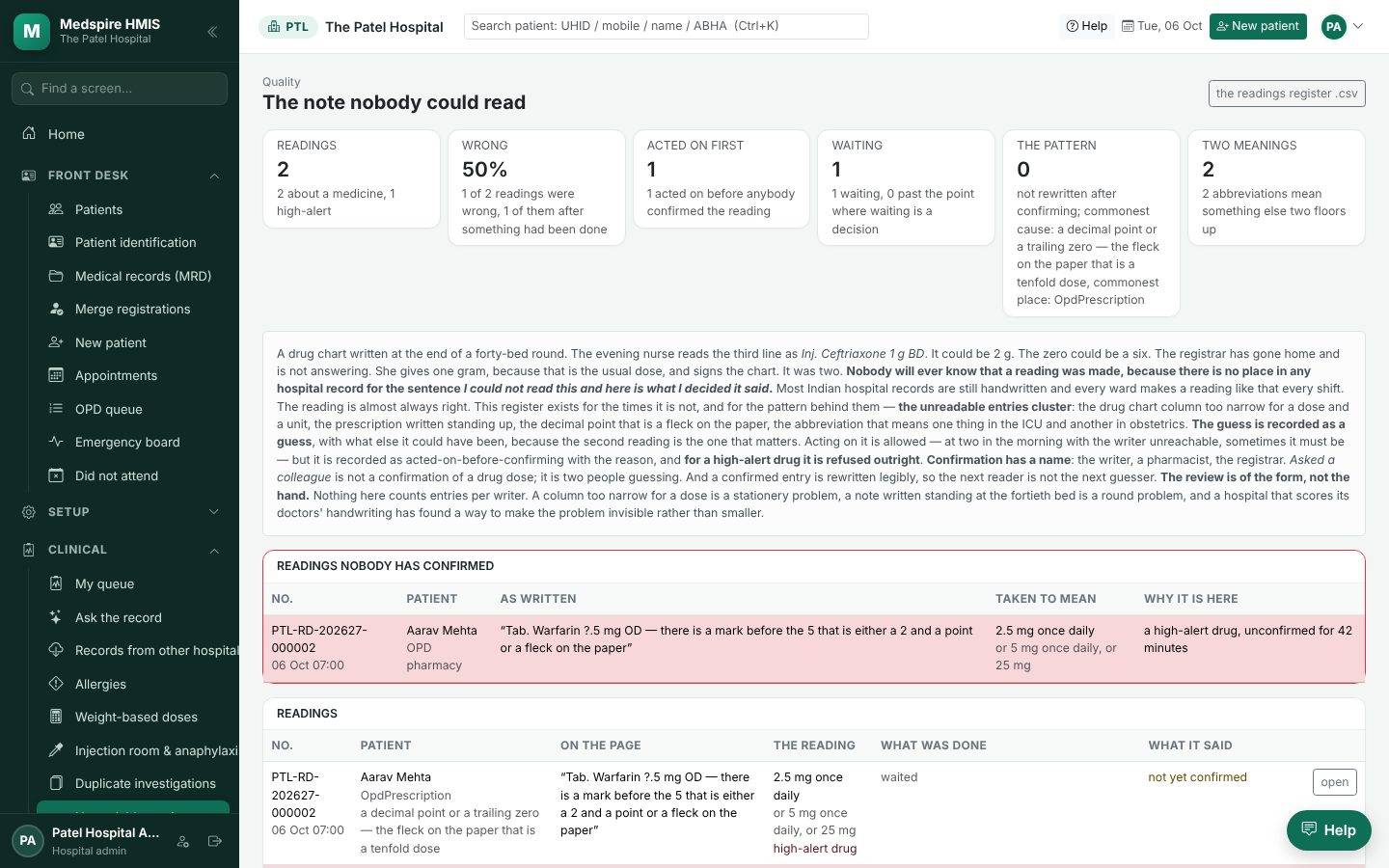
The entry somebody could not read: the guess recorded as a guess with its second reading, the high-alert drug not given on one, a confirmation with a name, the units' own shorthand written down once, and a review of the form rather than the hand
Why it exists
A drug chart written at the end of a forty-bed round. The evening nurse reads the third line as Inj. Ceftriaxone 1 g BD. It could be 2 g; the registrar has gone home; she gives one gram because that is the usual dose and signs the chart. It was two. Nobody will ever know that a reading was made, because there is no place in any hospital record for the sentence I could not read this and here is what I decided it said. Most Indian records are still handwritten and every ward makes that reading every shift; it is almost always right, and the register exists for the times it is not.
In the HMIS: /clinical/unreadable
Also in Clinical
My queue
Patients waiting for me
Ask the record
Ask questions over patient records (AI)
Records from other hospitals
ABDM — fetched under patient consent
Allergies
The allergy as an event rather than a word — what happened, how long ago and who says so; the labels worth challenging properly; and the drug given anyway recorded as the decision it is
Weight-based doses
Where the weight came from rather than only what it was, the per-kilogram rule kept beside the answer, and the doses still running from a weight that has since moved
Injection room & anaphylaxis
An observation period that comes from the drug rather than from the queue, a test dose recorded as the ritual it is, a tray with a date on it, and adrenaline intramuscularly into the anterolateral thigh at the right minute
Duplicate investigations
The same test ordered twice on the same patient inside its useful interval, usually by two teams neither knowing about the other, with the answer often already in the file when the second was ordered
Language & understanding
What the patient speaks against what the conversation was actually conducted in, who interpreted and whether they should have, what the patient could say back, and the sheet handed to somebody who cannot read it