
Product › Clinical › Weight-based doses
Weight-based doses
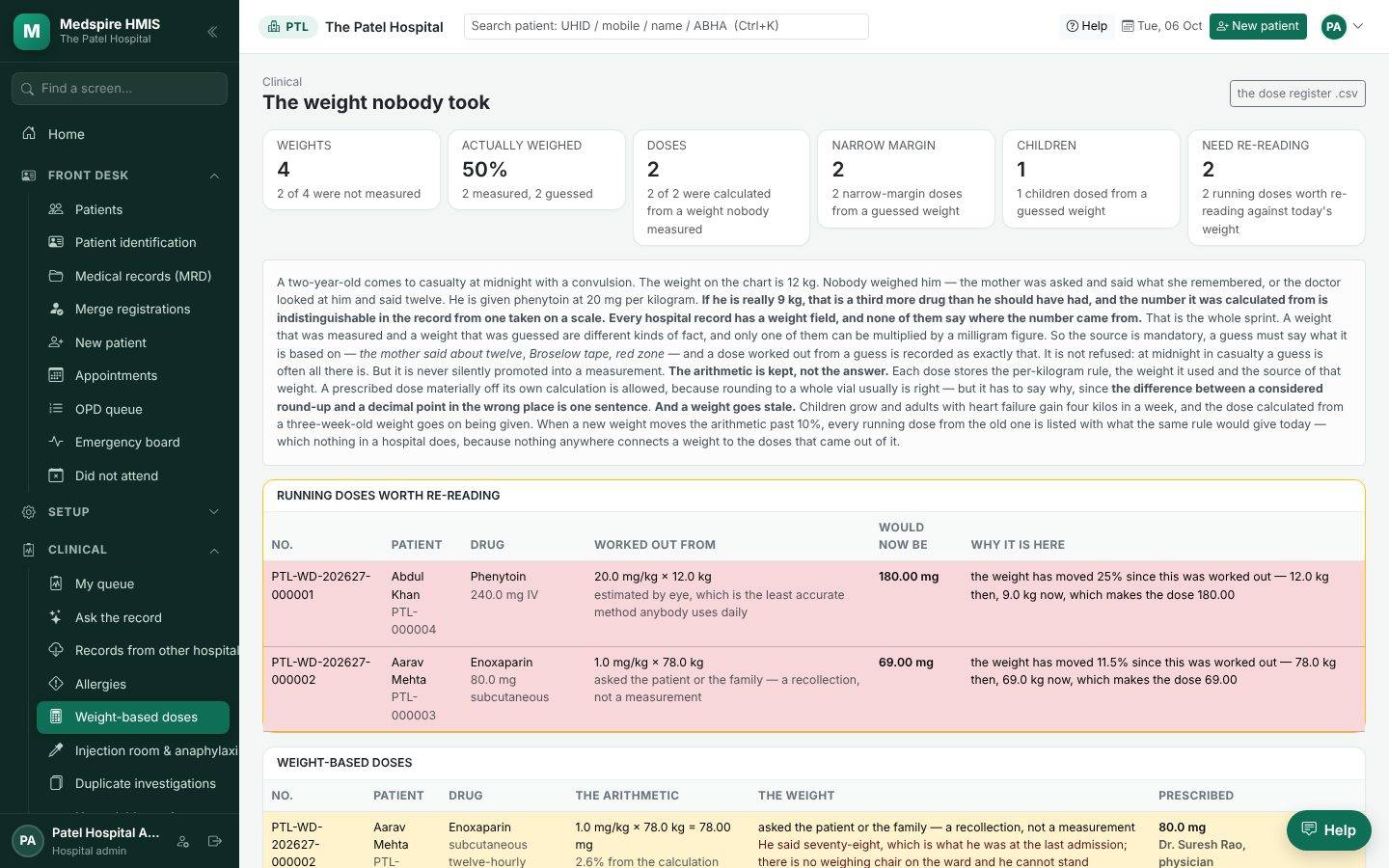
Where the weight came from rather than only what it was, the per-kilogram rule kept beside the answer, and the doses still running from a weight that has since moved
Why it exists
A two-year-old comes to casualty at midnight with a convulsion. The weight on the chart is 12 kg. Nobody weighed him — the mother was asked and said what she remembered, or the doctor looked at him and said twelve. He is given phenytoin at 20 mg per kilogram. If he is really 9 kg, that is a third more drug than he should have had. Sprint 2's vitals have a weight column; it does not say whether anybody stood the patient on a scale, and in an Indian hospital the honest answer is usually no. All three sources look identical in the record, and all three are then multiplied by a milligram figure.
In the HMIS: /clinical/weight-doses
Also in Clinical
My queue
Patients waiting for me
Ask the record
Ask questions over patient records (AI)
Records from other hospitals
ABDM — fetched under patient consent
Allergies
The allergy as an event rather than a word — what happened, how long ago and who says so; the labels worth challenging properly; and the drug given anyway recorded as the decision it is
Injection room & anaphylaxis
An observation period that comes from the drug rather than from the queue, a test dose recorded as the ritual it is, a tray with a date on it, and adrenaline intramuscularly into the anterolateral thigh at the right minute
Duplicate investigations
The same test ordered twice on the same patient inside its useful interval, usually by two teams neither knowing about the other, with the answer often already in the file when the second was ordered
Unreadable entries
The entry somebody could not read: the guess recorded as a guess with its second reading, the high-alert drug not given on one, a confirmation with a name, the units' own shorthand written down once, and a review of the form rather than the hand
Language & understanding
What the patient speaks against what the conversation was actually conducted in, who interpreted and whether they should have, what the patient could say back, and the sheet handed to somebody who cannot read it