
Product › Quality & safety › Major incidents
Major incidents
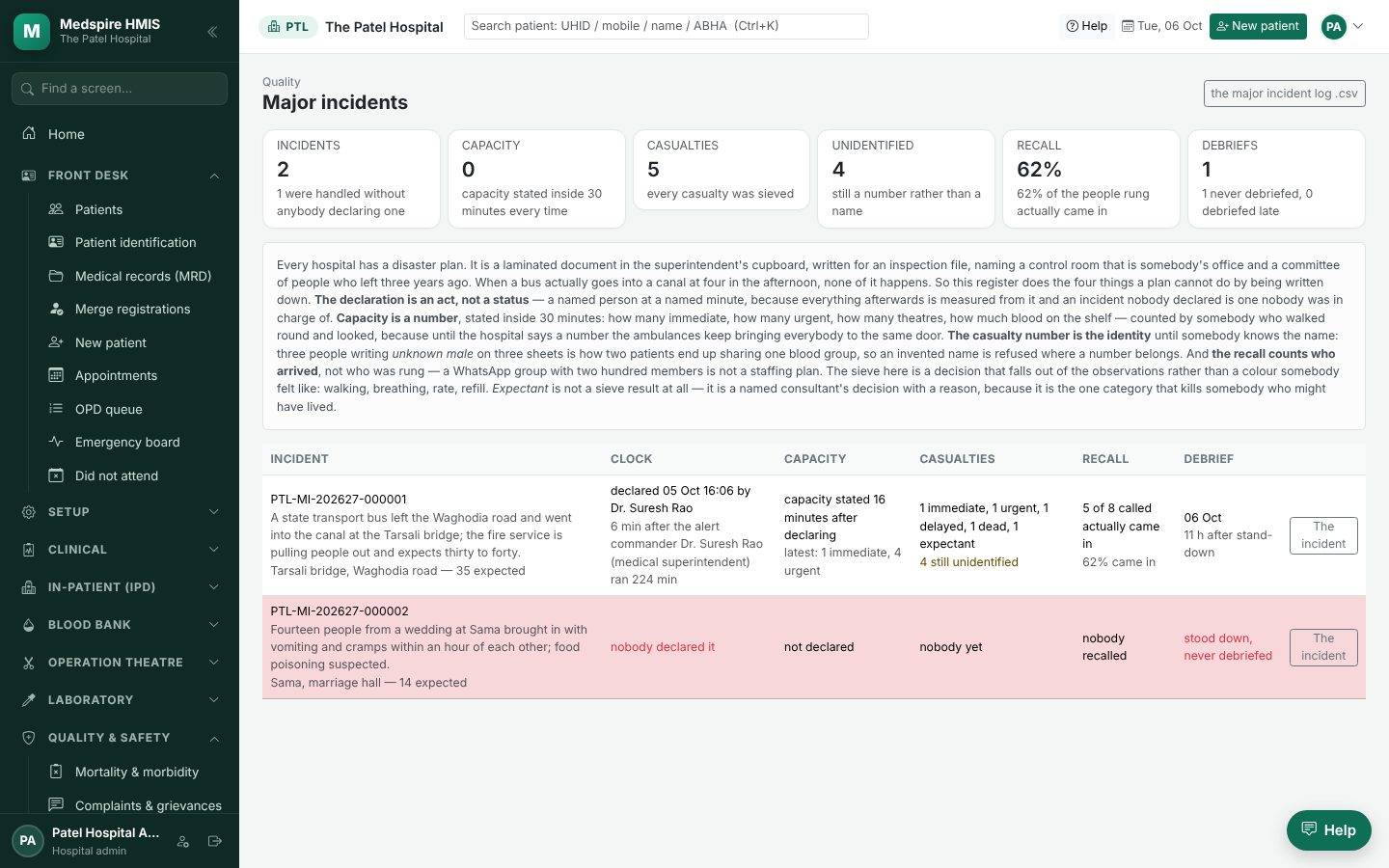
A declaration with a name and a minute, a capacity stated as a number inside half an hour, casualty numbers that are the identity until somebody knows the name, and a recall counted by who arrived
Why it exists
Every hospital in India has a disaster plan. It is laminated, it is in the medical superintendent's cupboard, it was written for an inspection file, and it names a control room that is somebody's office and a committee of people who left three years ago. When a bus actually goes into a canal at four in the afternoon none of it happens: everybody walks to casualty, nobody says out loud who is in charge, the unidentified are written on scraps of paper as unknown male 1 in three different handwritings, and the recall is a WhatsApp group nobody answers. A plan cannot fix any of that by being better written. Four records can.
In the HMIS: /quality/major-incidents
Also in Quality & safety
Mortality & morbidity
Every death found from the record, expected separated from avoidable, and a verdict that leaves the room
Complaints & grievances
Kept in their words, investigated by somebody else, answered in their language
Incidents & near misses
Raised from the build's own interlocks, and graded on what actually happened
Water plant & dialysis loop
A chlorine test taken between the two carbon tanks before the first patient, an action level at half the maximum, and a loop that does not go back into service until somebody has tested the rinse
Mortuary & body release
A cause of death written as a sequence rather than as cardiorespiratory arrest, a body identified against its tag number in front of a witness before anybody signs, a medico-legal death that stays the police's until they release it, and the registrar's twenty-one days
Fire, evacuation & drills
A horizontal refuge that names a place, escape routes walked rather than certified, an evacuation plan written bed by bed with the hands it needs set against the night staff, and drills whose findings have to close before the next one
Violence against staff
A named person rather than *staff*, the twenty minutes before rather than the blow, security measured in minutes, and the decision to talk somebody out of complaining recorded as a decision
Needlesticks & exposures
The sharps injury and the splash, with the clock running from the moment it happened rather than from the moment somebody found the form — the gap before anybody was told, the source patient's consent, the prophylaxis window, and a preventive action that names a thing rather than the injured person's carefulness